

Authors: Benedikt Wilde, Manuel Kaiser, Malte Reinschmidt, Andreas Günther, Dieter Koelle, Jószef Fortágh, Reinhold Kleiner, and Daniel Bothner
Phys. Rev. Applied 23, 064016 (2025)
Abstract: Hybrid quantum systems are highly promising platforms for addressing important challenges in
quantum information science and quantum sensing. Their implementation, however, is technologically
nontrivial since each component typically has unique experimental requirements. Here, we work toward
a hybrid system consisting of a superconducting on-chip microwave circuit in a dilution refrigerator and
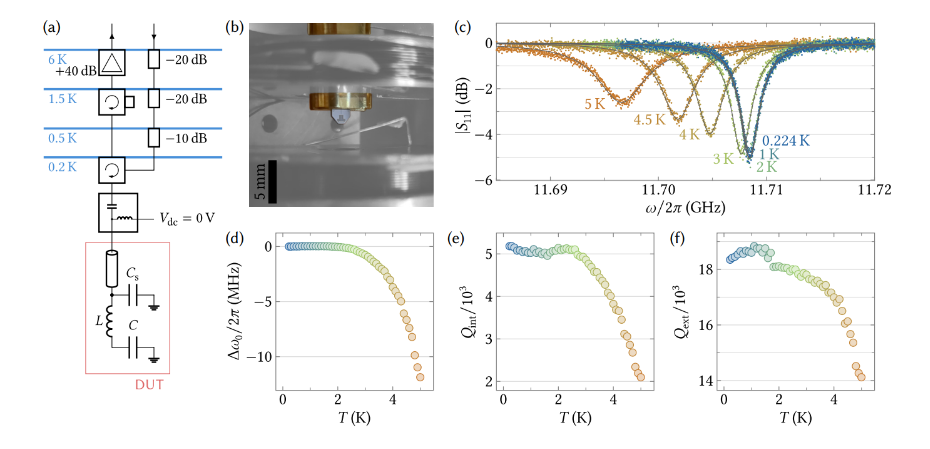
optically trapped ultracold atoms. Specifically, we focus on the design optimization of a suitable superconducting chip and on the corresponding challenges and limitations. We present detailed microwave-cavity engineering strategies for maximized and tunable coupling rates to atomic Rydberg-Rydberg transitions in 87Rb atoms while respecting the boundary conditions due to the presence of a laser beam near the surface of the chip. Finally, we present an experimental implementation of the superconducting microwave chip and discuss the cavity characteristics as a function of temperature and applied dc voltage. Our results highlight the considerations required for realizing a flexible, tunable superconductor-atom hybrid system and lay the groundwork for realizing this exciting platform in a dilution refrigerator with vacuum Rabi frequencies approaching the strong-coupling regime.